I was reading some old interviews with Gillian Welch recently and in one she mentioned the important influence of her college professor Pat Pattison. Intrigued, I went on to do some further research into how this iconic songwriter learned her lyrical trade.
Welch had studied under Pattison at Berklee College of Music in Boston, where she also met her musical partner David Rawlings, both graduating in 1992. Pattison had established the first songwriting course at the University, after originally teaching a course analysing contemporary lyrics in the English department.
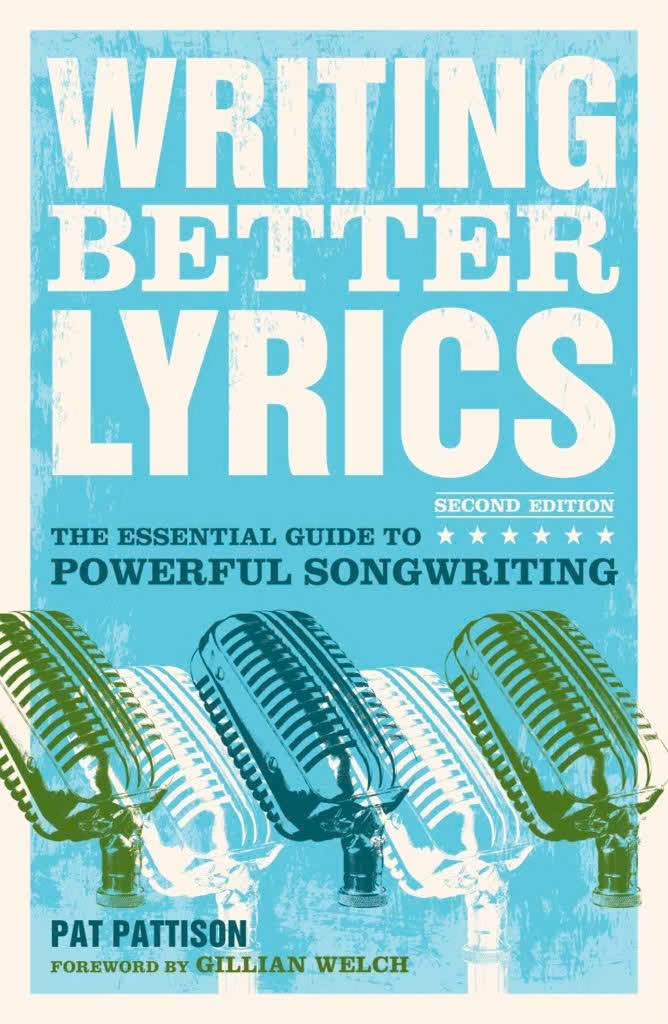
Pattison’s work has now gone on to become hugely influential with his 1995 book Writing Better Lyrics still in constant circulation and his songwriting course having been taking by millions of students in person and online.
Gillian Welch wrote the introduction to the 2009 edition stating: ‘I would not be the writer I am today without his teaching’ and she cites how when she’s struggling she reads the book again for advice.
For those, like myself, who don’t write lyrics but are interested in those who do this book is a richly illuminating handbook. Writing good lyrics becomes an art, not an accident. The content on metaphor, rhyme, prosody etc is complex to read and I imagine requires intense effort to master.
One of the central exercises that Pattison advocates for is what sounds on the surface to be a simple prompt: write about an object, using the senses. When Welch was asked the most important takeaway from her entire time as a college student of music at Berklee she answered: ‘Object writing, no question.’
In his book Pattison advocates for object writing ten minutes a day every morning. For him consistency is the key to unlocking creativity.
The task also works well with others. The book tells of how Gillian organised her own ‘Object Writing’ group in Nashville for many years.
The group would meet on a Sunday and all write on the same object, share their ideas and then repeat for different objects. They wrote for varying amounts of time from ninety seconds to ten minutes. After a couple of hours the writers would have described around nine different objects. Some of the example objects in the book include: puddles, pepper and popsicles.
Some of the results of this writing exercise in the book are beautiful. I’d love to have sat in and heard what Gillian’s group came up with every week (and I wonder who else participated!) It’s astonishing that what seems like such a simple task can be the foundation of such inventive lyric writing.
In a great old New Yorker profile Welch’s mother nicely summed up her daughter’s main skill, saying: ‘Really, what’s she’s done her whole life is pay attention.’
Object writing is taking time to pay attention. A form of written meditation.
This simple task would pair nicely with Julia Cameron’s ‘Morning Pages’ ritual, which involves writing three pages of unfiltered writing every morning. At least with object writing there is a prompt that can get you going – just look around the room. I think everyone, not just lyricists, could benefit from this attention to the page and the world around them.
For anyone afraid of this kind of free writing I refer to this sage advice from Pattison: ‘Don’t be afraid to write crap, because crap is the best fertiliser. The more crap that you write the more likely you’ll grow something amazing.’
The other tasks in his lyric writing book become increasingly more complex, as you would expect. Object writing may just be the fertiliser of a song’s seed but there’s something about this as a core writing habit which is inspiring in its simplicity and accessibility.
If it’s good enough for Gillian…
Buy the book : https://www.amazon.co.uk/Writing-Better-Lyrics-Pat-Pattison/dp/1582975779
 Highway Queens
Leave a comment