
‘I was an imitator; you have to start that way.’ – Emmylou Harris
Finding your voice is never as simple as opening your mouth and hoping you hit the right notes. Rarely do artists arrive fully formed, with something to say and a distinctive voice to carry them into the public consciousness. The history of music is littered with the sound of people hoping to find success by emulating others, many straight up stealing ideas in a desperate form of mimicry.
Work produced during this youthful development stage is referred to as juvenilia. If you make it to the other side of this time of experimentation and exploration then you might just have what it takes to become something original. Of course, once you become a success there is a level of embarrassment associated with this early work and indeed Emmylou Harris’s discography begins with Gliding Bird, an album she is so averse to that she no longer even classifies it as her debut. She actually sued a record company who tried to reissue the album after she became famous.
“I was trying to keep it a secret. I hope somebody in authority will be able to buy the masters and burn them. Everybody involved with that record hated everybody else and I was in the middle trying to keep the peace. It was a disaster.”
The album can be bought on second hand vinyl and some of these copies have been recorded and uploaded onto YouTube (in the internet age you can’t hide your past even if you wanted to).
So let’s take a listen and find out exactly what went wrong with Gliding Bird. Are there any positives to be found in this album? Was Emmylou right to disown this record?
Firstly what I found most interesting and illuminating about this album was the influence of Joan Baez and Joni Mitchell. So much of Emmylou’s musical history and development is credited to Gram Parsons, that it was actually refreshing to hear that much of her early foundational influences are actually other women.
As a 16 year old she heard Joan Baez’s debut album, bought herself a guitar, learned three chords and began to try to become her idol. ‘I worshipped her,’ Emmylou said. Despite her youthful musical pursuits she was also academically gifted and interested in theatre, going to college to study acting. However she soon realised where her heart lay, dropping out and moving to New York in 1967, playing in coffee houses before signing to Jubliee Records in 1969.
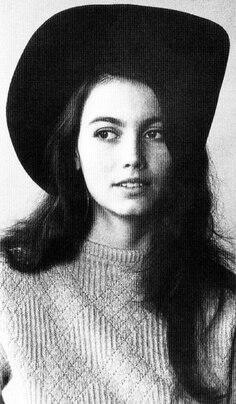
Another interesting feature of this album is the glamorous styling of the original cover art, where her beauty is framed by quite a resplendent hat. Perhaps this cover is another reason Emmylou dislikes the album – there’s too much of the beauty queen in the image, quite in conflict to the natural, more relaxed hippie style she became known for.
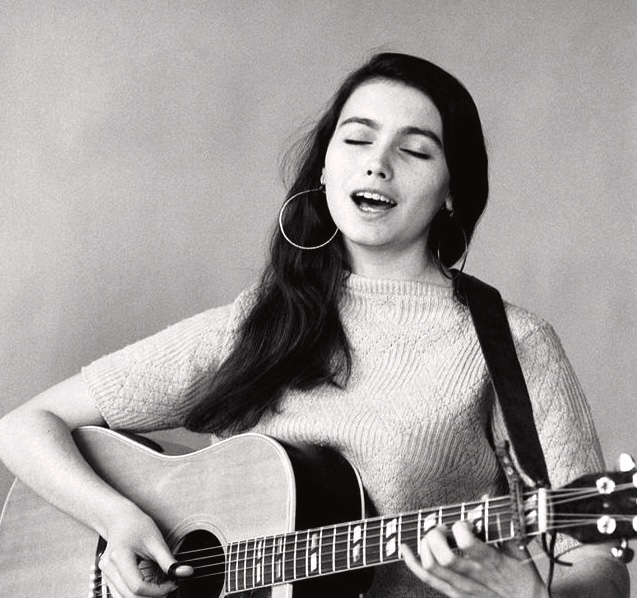
Gliding Bird was produced by Ray Ellis who had worked with an array of female artists including Sarah Vaughn, Barbra Streisand and Billie Holiday. Those artists were known for a more formal style of orchestration, which also seems to be in conflict with Emmylou’s folk music influences.
Yet looking at the musical choices on this record, you can see a lot of what Emmylou would become. The album begins with a nice cover of Dylan’s I’ll Be Your Baby Tonight. Maybe her voice doesn’t sound exactly as lovely as she would come to be known for, but there’s an engaging tone and enough personality here to make it an enjoyable listen.
What’s also intriguing is how many of these songs are solo written, in a style obviously mimicking Joni Mitchell. ‘Fugue for the Ox’ is a lyrical cousin of The Circle Game, using a merry go round as a metaphor for life. Later Emmylou described herself as mainly an ‘interpreter’ of songs written by others, here you see her attempt to write an original lyric which may be somewhat derivative, but is not entirely without success. The title is somewhat ambiguous in terms of the connection to the song – a ‘fugue’ is a musical composition in which one or two themes are repeated in a continuous interweaving, and suggests again some form of ambition within her songwriting. The Ox is a religious symbol of strength and protection, someone who watches over Jesus in the manger, again showing thoughtful, if not entirely realised, songwriting ideas.
I Saw The Light sounds like an artist trying to find her own singing style, sometimes it works and other times her vocals are a little raw. Here is also more evidence that Emmylou was naturally drawn to country music even before she met Gram – further underlined by her wearing a cowboy hat in some press pictures and moving to Nashville after the release of this album.
The best song on here is Clocks, which has a softer, more natural vocal approach, almost like a lullaby. Lyrically the song is about time and fading love, with lines like ‘Counting hours making days/ Watching time throwing love away/ Nothing golden never stays.’ The song appeared on her album of rarities and b-sides, which makes it therefore the only song from this album to actually be officially available to buy, albeit in a pricy box set.
Black Gypsy is another self-penned song, this one a dark tale of urban isolation, suggesting she was finding it difficult to live in New York at the time. ‘Broken outlets, broken songs, broken faces been in town too long.’ The song too probably goes on too long and dececends into a dirge but there’s something truthful and beautiful in its melancholic tone. After this album Emmylou would move away from New York, saying it ‘seemed dangerous to me. I just felt very vulnerable.’
The title track of the album was written by her then husband Tom Slocum, with whom she was obviously having a difficult relationship with at this time. The lyrics seem to be a reflection of their unspoken problems:
Gliding bird high above the sea
Is it longing to be free
Your voice is silent
But your wings tell all
Her voice is really Joni-esque on this one but it is somewhat unwritten and fades out before it really goes anywhere emotionally.
We then have a half-hearted cover of Everybody’s Talking, where she sings the melody quite slowly above a sweep of strings.
‘Bobbie’s Gone’ is an interesting song about a dreamer who is trying to become a success. Here the lyrics are somewhat confusing – who is Bobbie? Why is she always going to California every year? Is she a metaphor for Emmylou herself? In the end ‘Bobbie’ ends up with faded dreams – a premonition of what Emmylou’s own life would become soon after this album was released.
‘I’ll Never Fall in Love Again’, was of course made famous by another Bobbie, whose influence can definitely be heard in some of the phrasings and arrangements on this album. Emmylou’s version of this Bacharach song is slowed right down, giving an emotional weight to the delivery, but making it pale in comparison to other well-known versions.
Waltz of the Magic Man is more upbeat and sweet, her singing is almost unrecognisable and entirely in the Baez/Mitchell style. The lyrics tell the story of falling in love with a man called Tommy who sweeps her onto the dance floor. There’s even a mention of Dolly’s Coat of Many Colors, a song she would later go on to cover.
After the album was released Jubilee records folded, she became pregnant, her marriage fell apart, and she was forced to move back home with her parents. The Gliding Bird had plummeted to the ground in spectacular fashion.
As a teenager Emmylou had written to Pete Seeger because she wanted to become a folk singer, but she felt she was a fraud as she’d lived such a happy, privileged life. He responded with the advice: ‘Don’t worry about suffering, it’ll happen.’
Here was the suffering he had predicted both on a personal and professional level, failures which would ultimately propel her towards an alternative destiny – not as a folk singer, but as a country star.
In the past Emmylou called her debut album ‘terrible’ but more recently has softened somewhat, saying:
‘The good thing about that record is that it shows that I was very much into songwriting. Half the songs on there, they’re not the greatest songs in the world, but I’m not embarrassed by them. I wrote like half the album. And I think the song selection, for the most part, was pretty good. I did a Dylan song and a Hank Williams song. So there were some seeds of what was to be.”
Gliding Bird is a seed that didn’t grow, a musical beginning that needed to be transplanted elsewhere to truly flourish, but there are signs of the beauty and blossom to come.
Here are some videos of Emmylou performing in this era:
If you’ve read this far please consider subscribing to my FREE weekly newsletter for song recommendations, new and classic album reviews and much more:
 Highway Queens
Thanks, Michelle. Emmylou is one of my favourite artists, but I knew little about this early album. For one thing, I wasn’t aware that she’d included five self-written songs
While the Gram Parsons collaboration was to be important in showing her the wider potential of Country Music, and perhaps in encouraging her to develop the catches and keelings that gave her later voice that characteristic Country feel, I do agree with you that his role in the career that she developed has probably become overstated. Including a Hank Williams cover on a debut album shows confidence – and proves that an awareness of the genre’s potential was already there.
Are you planning an album-by-album series on Emmylou (as with Dolly’s discography)?. It’s a lot of work, but I certainly appreciate the detail and interesting judgments you include in your reviews!
LikeLiked by 1 person
Hi there – thanks for reading! I appreciate your comments. And yes I am hoping to do an album by album series (working on the second one as we speak). I am a little slow at the moment due to work commitments but I don’t mind taking my time and savouring some Emmylou!
LikeLike