After Dolly’s death this week the tribute statements and social media posts flowed in from family, friends, collaborators, fans and people all over the world. Her longtime friend and Trio collaborator Emmylou Harris did things differently.
Emmylou is now 79 herself and was in Europe playing her farewell tour. She had made no public statement about Dolly’s death. Instead she chose to open her show on Wednesday evening in Stockholm, Sweden alone with an acoustic guitar by singing ‘To Daddy’, a song written by Dolly which she had been gifted by her friend back in the seventies.
At the end of the track she simply said ‘I love you, Dolly.’
It was a fitting tribute to a musical connection that began many decades before. The story of how Emmylou came to record ‘To Daddy’ for her fifth album ‘Quarter Moon in a Ten Cent Town’ sums up much of what everyone loves about Dolly Parton: her talent, her kindness and her steely ambition.
When Emmylou visited Nashville in the mid-70s, Porter invited her down to the studio to hear what Dolly and him were working on. One of the songs was ‘To Daddy.’ Immediately Emmylou wanted to record ‘To Daddy’ for herself. The tragic song about a woman struggling with a loveless marriage and only being ‘a mother and a wife’ resonated emotionally with Emmylou.
Despite Porter Wagoner’s angry objections Dolly gave Emmylou the song, telling him ‘It’s my song and I’m trying to build myself up as a songwriter.’ Emmylou got the song and it became a huge hit.
Dolly said in her book ‘Songteller’ that ‘A lot of stars had recorded my songs before Emmylou Harris. But her version of ‘To Daddy’ meant more to me than any of them. We’ve been friends ever since.’ While this decision obviously cemented their friendship and musical connection it also tells you much about Dolly’s ambition too. She wanted to be seen as a songwriter first. She wanted the credibility of her songs succeeding and living on without her as the singer.
Now she’s gone, her work is done and she can rest easy knowing that Emmylou is just one of many who will keep her songs alive.
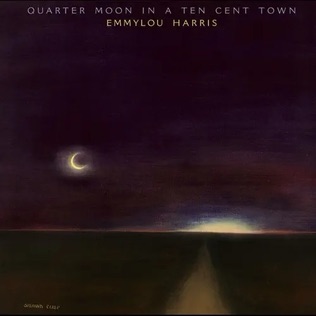
The album ‘Quarter Moon in a Ten Cent Town’ also showcases the artistic and musical talent of Susanna Clark, another female songwriter who would become a close friend of Emmylou’s. The album was named after a line in the opening song ‘Easy From Now On’ written by Susanna Clark and Carlene Carter. Susanna’s painting is the cover art of this album too, the first not featuring Emmylou’s face. The song is a story of a woman finding resilience and a way to live after heartbreak. Miranda Lambert covered the song on her Crazy Ex Girlfriend album and then used the wildcard line in her song ‘Bluebird’ and as the title of her album, showing how the firecracker spirit of the song still resonates today.
‘Two More Bottles of Wine’ is a barnstorming alcoholics anthem, one of Emmylou’s signature songs and it sounds as fresh as that first sip. I’m certain that part of Emmylou’s success and wide appeal is that she sang a lot of songs written by men about hard living and drinking. How much of these songs are her own life is irrelevant when she sings them so well and the band are so damn good.
Emmylou’s voice has rarely sounded as ‘pure and delicate’ (as Dolly once said) as on ‘Songbird’ written by Jesse Winchester. Using the metaphor of the caged bird, she sings beautifully of wanting to hold on to what you’ve long understood should be freed. The band sounds as sublime on this one as ever. The other song written by Winchester on the album ‘Defying Gravity’ is another pure ballad which may lack lyrical depth but has Emmylou humming a beautiful melody all the same. The production of this one is a little odd now in comparison with the rest of the album, with its spare and almost eighties glossy sound.
What I love about this album is the variation of tone and ‘Leaving Louisiana in the Broad Daylight’ has a rocking tempo and Cajun influences in the story of how ‘the highway goes on forever’. This one was written by Rodney Crowell and Donivan Cowart, going on to become a huge hit for the Oak Ridge Boys.
The real highlight of this album though is hearing Emmylou properly rock out on Rodney’s classic ‘I Ain’t Living Long Like This’. Her voice finds a new kind of grit, her storytelling leading us easily to believe that she’s flipped from being ‘your little ole angel’ to a ‘roadhouse queen’. The hot band too make this one a rebel yell of fun. Waylon would go on to make this one a number one hit and while his hard living reputation added a layer of authenticity to the song, Emmylou’s version holds up well too.
We then have a quieter moment of contemplation with Willie Nelson guesting on the gorgeous story ‘One Paper Kid’ about a tragic drifter killed by a drunk driver. They sound wonderful together, as you would expect.
‘The Green Rolling Hills of West Virginia’ takes us to the country, a song written by Utah Phillips that celebrates the beauty and the troubled history of these rolling mountains and how you can never escape where you’ve come from. Fasyssoux Starlings offers her support on vocals for this one. The fiddle too adds that haunting feeling, echoing the Celtic music that has influenced so much of country genre.
The final song on the album is ‘Burn That Candle’ written by Winfield Scott. Emmylou goes for a little twang on this one, foreshadowing the pure country that she would embrace on her next album Blue Kentucky Girl.
On ‘Quarter Moon in a Ten Cent Town’ Emmylou offers a chance for us to hear her vocal range and versatility, proving she’s got more than a few wildcards up her sleeve. Emmylou is a songwriter’s singer, as her tribute to Dolly so poignantly shows. She’s someone who is more comfortable taking on a persona inside a song, perhaps a reflection of her original aspirations of acting. Yet the emotional truth of the songs feel deeply personal, as though she is connecting not just with her audience but with the songwriter themselves. No wonder then that so many of them became her lifelong friends.
Previous: Luxury Liner (1976)
Next: Blue Kentucky Girl (1979)

